

External Scan

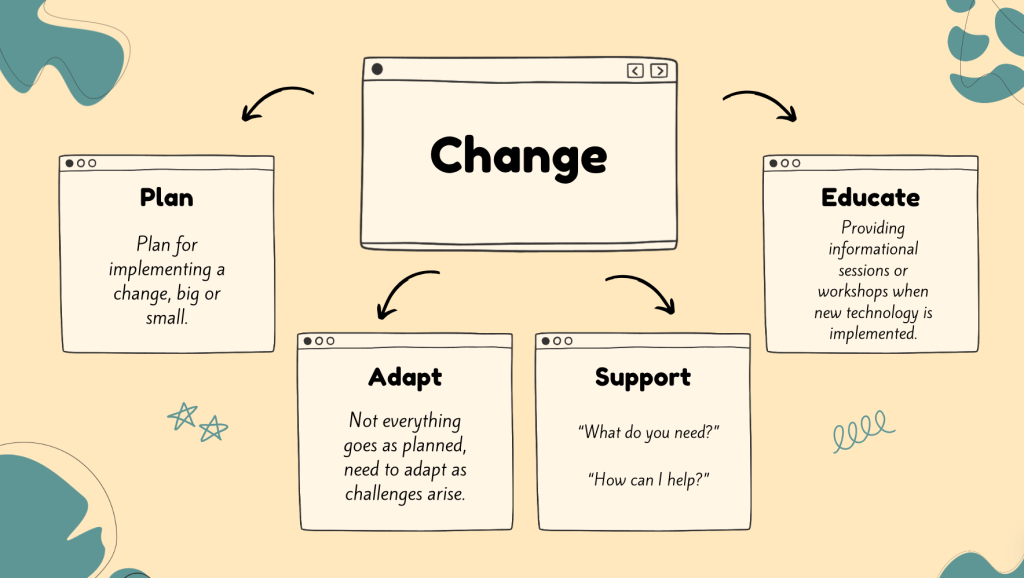
Image template source: @arfamojila on Canva
Reading about change management and the various models that could be used was mind-opening (Al-Haddad & Kotnour, 2015). Discussing change and change management with colleagues allowed me to narrow down four important key points for change. These four key points are planning, adapting, supporting, and educating.
Recently, the daycare has gone through a significant change in that it expanded and doubled the amount of children in the centre. Both colleagues I discussed with mentioned the planning it took the leader to make this change go as smoothly as possible (C. Bentivegna, personal communication, February 9, 2024).Because the expansion was happening while the rest of the daycare was open, the director ensured the children already enrolled could still come as we could not shut down. Thus, ensuring the daycare remained open took much organization and planning. Regarding technological change, each class has recently been supplied with laptops.
The provided laptops were to help educators plan activities, create a weekly schedule, and move towards creating the children’s portfolios using Microsoft Publisher instead of printing, glueing, and handwriting comments on paper. The provision of laptops also took much planning as the director needed to discuss the idea with the board of directors to get approval, and only then could the laptops and necessary software be provided. Of course, this was with some challenges, which brings up the idea that a leader must be adaptable.
My colleagues and I discussed the need to make adaptations during these changes. While the director was organized and had planned for the change, there were some setbacks. Some setbacks involved were the delayed delivery of the materials, causing the two new daycare rooms to not open on time while the children were still coming to the daycare. Thus, the educators and director needed to adapt by briefly having the children enter a different class (C. Bentivegna, personal communication, February 9, 2024). Regarding the laptop, the educators needed to adapt to that change as they were not used to using the software implemented to create the children’s portfolios (A.B. Reis, personal communication, February 14, 2024). These two changes were extensive and required the director to plan and adapt accordingly.
Both changes mentioned are on a large scale as they involve much planning, adapting, and vision (Al-Haddad & Kotnour, 2015). The board of directors was involved in both the expansion and the decision to provide the laptops, and the educators were asked for their input. While no formal change management method was mentioned, based on discussions and the strategies discussed by Al-Haddaded and Kotnour (2015), the organization seemed most similar to the Jick and Kanter method. This method has ten phases, and through the conversations I had with my colleagues, a few of them were brought up. The director analyzed the need for change, created a vision, developed a plan, communicated these ideas to the educators, and reinforced the change by providing necessary support.
The implementation of laptops was where employees expressed their apprehension the most. As one of my colleagues mentioned, they were worried about using laptops as they are not the most tech-savvy (A.B. Reis, personal communication, February 14, 2024). On the other hand, my other colleague was relieved as it helped to make planning, finding activities and making portfolios more efficient (C. Bentivegna, personal communication, February 9, 2024). These differing opinions on this change are reminiscent of Weiner’s (2009) idea about change valence, as one colleague saw the value in the laptops right away compared to the other who was unsure about using them. Thus, the question was, what did the educators need to be at ease with using this new software? How can the director help with those needs? The director saw this apprehension and offered support by providing them with informational sessions on using the software.
In order to support these educators, the strategy used was informational, where the educators were taught how to use the software through step-by-step workshops (Biech, 2007). If this session was not enough, she provided the educators with one-on-one sessions, which one colleague said was valuable to help increase their understanding of using the software (A.B. Reis, personal communication, February 14, 2024). The director still provides these informational sessions as new employees are onboarded throughout the year. These sessions are still valuable to employees, new and old, as the workshops are constantly evolving based on differing needs. Ultimately, the educators feel supported and more comfortable using the software.
To conclude, these four key elements are what my colleagues felt were essential to making successful changes in the daycare. What was interesting about coming up with these elements was the experience they each had at the daycare, one colleague having over thirty years and another having six. While the amount of experience here differs, they both discussed the need for a leader to plan, adapt, support and educate. Thus, it shows that these four elements are valuable for a leader during a change.
References
Al-Haddad, S., & Kotnour, T. (2015). Integrating the organizational change literature: A model
for successful change. Journal of Organizational Change Management, 28(2), 234–262.
Biech, E. (2007). Chapter 3: Models of Change. In Thriving Through Change: A Leader’s
Practical Guide to Change Mastery (pp. 21–33). essay, ASTD Press.
Weiner, B. J. (2009). A theory of organizational readiness for change. Implementation Science, 4(1). https://doi.org/10.1186/1748-5908-4-67
Comments