

Research Log: User Experience

In my initial post about researching AI for personalized learning, I wanted to investigate the credibility and accuracy of using these tools for language learning. My idea was to use both Duolingo and ChatGPT to compare the information given to me when learning French. However, while I have a basic understanding of French, it would be difficult to test the credibility and accuracy of the information, so I decided to switch my topic to user experience instead.
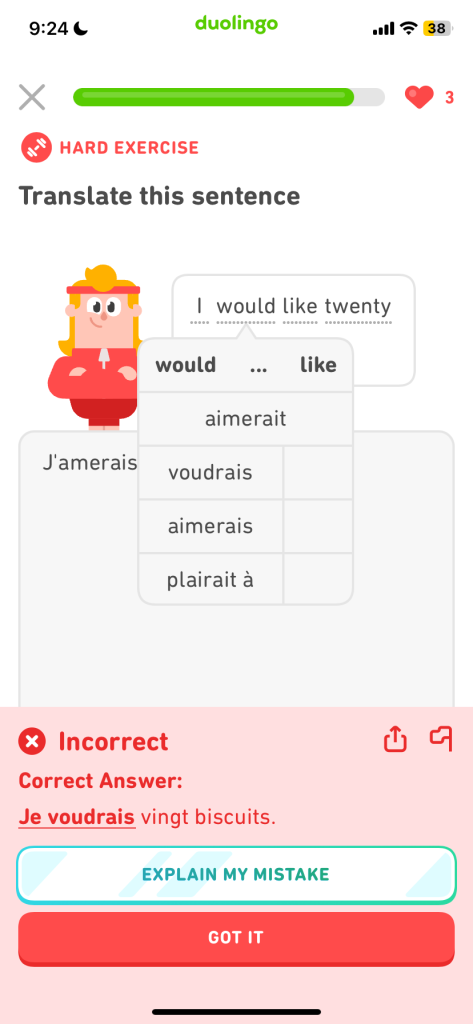
The mobile application Duolingo is not new to me; I have used it but have never taken the time to examine it as a user critically. As Anderson and Charaf (2020) pointed out, when looking at user reviews in the Google Play Store, many people discussed that paying a monthly subscription fee is the best use of the app. There are now two tiers of a paid subscription: Super Duolingo and Duolingo Max. While both tiers offer unlimited hearts and practice, DuolingoMax is where you can get a lot more personalized learning, as it will explain your answers or mistakes. You can roleplay (Duolingo Team, 2023). I currently only use the free version, and so far, there are things I enjoy, such as being easy to navigate (Munday, 2015); gamification is a motivator as it reminds me to keep practicing and gives me points. The downsides are limited lives, inability to practice mistakes, and inability to get explanations for my mistakes. To get the whole experience with Duolingo, near the end, I will use the free trial of Duolingo Max.
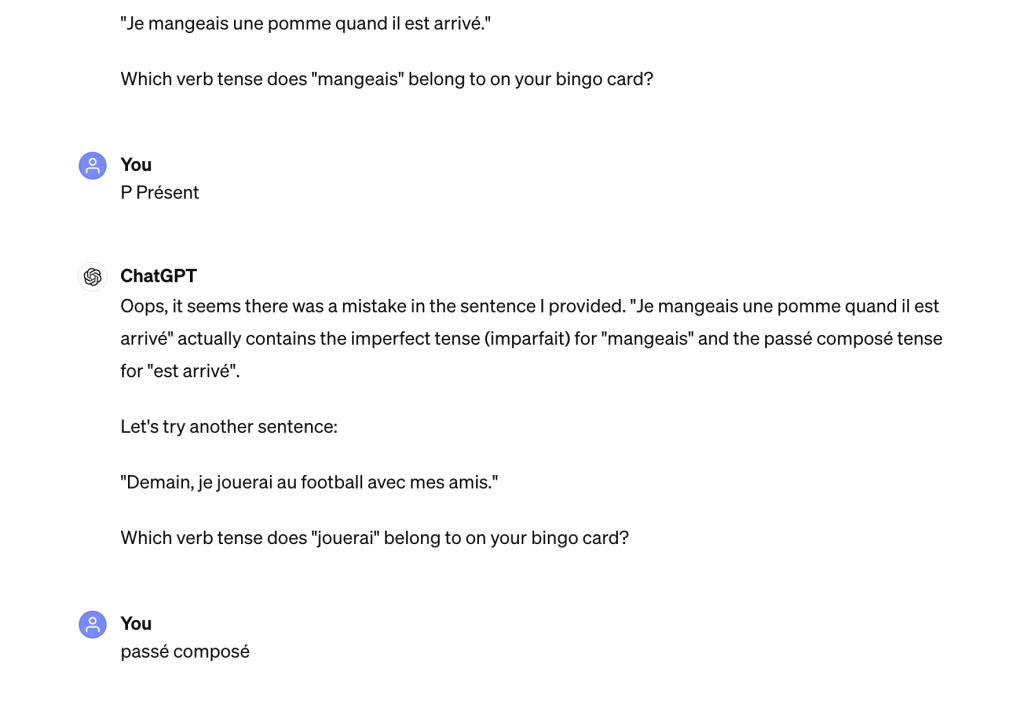
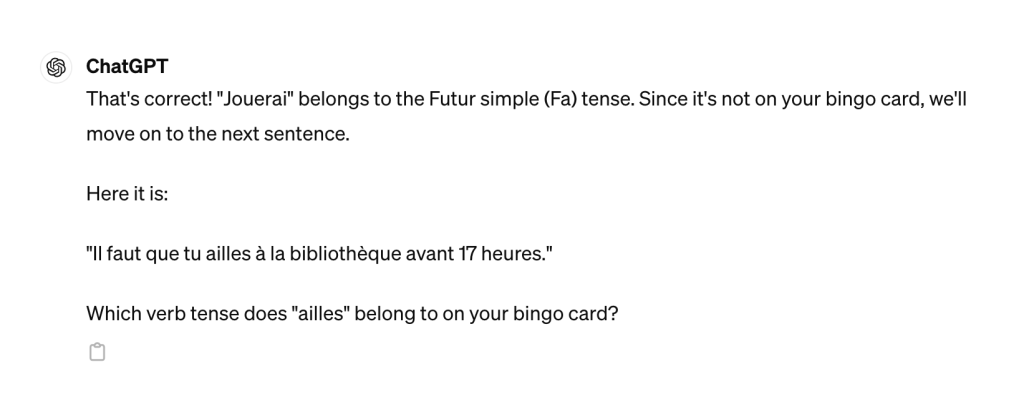
I have also been using ChatGPT to learn French. When using a tool like ChatGPT, it is essential to be mindful of wording your prompt (J.White, personal communication, April 12, 2024). My first time using the tool, I wanted a refresher on conjugating verbs to the proper tenses but in a more engaging way. After a few prompts, I decided to try a bingo game; ChatGPT would give me a conjugated verb, and I would have to write the tense in which it is. While the game was simple enough, I did catch some errors, such as inputting the wrong tense, but the program told me the answer was correct. While Huang and Li (2023) mentioned that using this tool can weaken people’s abilities to self-correct, I used it to double-check my answer with a verb conjugation website: https://leconjugueur.lefigaro.fr/. Thus, while using ChatGPT is not perfect, it allows me to check my work, and then I can correct the program by letting it know my answer was incorrect. A positive thing about using this tool is that I immediately get instant feedback and explanations, which I do not do with Duolingo.
As I continue to use these tools, I will also be critically aware of the potential for mistaken information and the program's biases (Huang & Li, 2023). Further, I have yet to try using speech recognition with ChatGPT; there have been studies where students experienced tools like this needing help with speech recognition (Jeon, 2022), so this is something else I will explore. I have a question: How effective are AI-empowered applications in personalizing language learning?
References
Anderson, P., & Charaf, A. (2020). The reviews of users of the duolingo application: Usability and objectivity in the learning process. International Journal of Research - Granthaalayah. https://doi.org/10.29121/granthaalayah.v8.i9.2020.1326
Duolingo Team. (2023, March 14). Introducing duolingo max, a learning experience powered by GPT-4. Duolingo Blog. https://blog.duolingo.com/duolingo-max/
Huang, J., & Li, S. (2023). Opportunities and challenges in the application of chatgpt in foreign language teaching. International Journal of Education and Social Science Research, 06(04), 75–89. https://doi.org/10.37500/ijessr.2023.6406
Jeon, J. (2022). Exploring ai chatbot affordances in the efl classroom: Young learners’ experiences and perspectives. Computer Assisted Language Learning, 37(1-2), 1–26. https://doi.org/10.1080/09588221.2021.2021241
Munday, P. (2015). The case for using duolingo as part of the language classroom experience. RIED. Revista Iberoamericana de Educación a Distancia, 19(1). https://doi.org/10.5944/ried.19.1.14581

Comments