

A Trip Down Ed Tech Memory Lane-Videos
- Catherine McFee
- Sep 10, 2023
- 3 min read

While reading the second part of Weller's (2020) book, spanning 2002 to 2011, I felt a few chapters were relevant to what I have experienced as a student and teacher. The chapter I chose to focus on is Chapter 12: Videos.
In the companion podcast hosted by Laura Pasquini (2021), she and her guest, Lee Skallerup Bessette, discuss both videos and other forms of media that can be used in learning. A topic that was brought up was the idea of teachers being purposeful in using videos and other forms of media when teaching. While I was a student teacher, I was strongly encouraged by my university professors to include technology in most of my lessons. As I reflected on how to do so, I knew I wanted to use technology mindfully. While teaching, my cooperative teacher helped me plan a unit for black history month. One of the topics the school was focusing on was the history of black hair. I found the book Don't Touch My Hair by Sharee Miller, and the children were interested in it. Instead of reading the book to them, I used a YouTube read-aloud, allowing the students to see the text on a bigger screen with added captions.
I researched the author and noticed she offered virtual meet and greets with schools, so I reached out to her and organized a time in which she would be able to meet with both my classes simultaneously. My intention in using a live stream with the author was for the students to have the chance to discuss different topics such as black history, writing stories, becoming an author and more. Thus, using a live-streaming video in such a way was meaningful as it contributed to their learning and based on their interests.
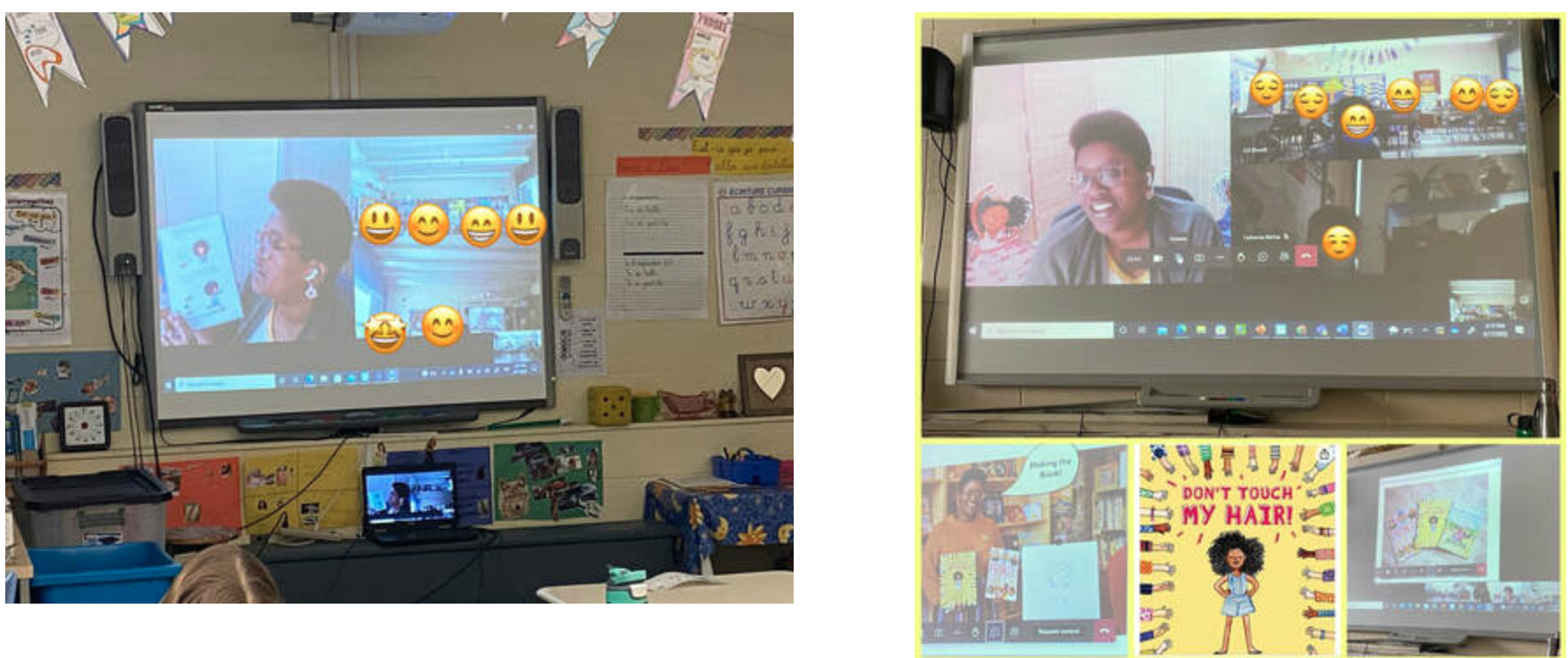
However, there is a privilege of having access to the type of technology that would allow such a lesson to occur. As Pasquini and Bessette (2021) and Weller (2020) mention, there is a lack of access to these technologies for some students (this could be due to having no internet at home or not having a laptop to do the work on). Thus, when considering incorporating videos or other media forms, I kept it in school to ensure all students could participate. Reading the chapter and following along with the podcast showed me the importance of reflecting upon certain education technologies, especially when discussing universal design and student access.
Moreover, while reading the chapter, Weller (2020) mentions that the use of videos as an assessment tool "is still relatively limited" (pg. 89). I found that incredibly interesting due to my experience in secondary school, where I had multiple instances in using creating videos as an exam or final project. Perhaps it was not a popular assessment form in the last few years, but when I was in secondary school (2008-2013), I remember various opportunities to create videos showing my learning. For instance, instead of writing about something newsworthy in my French class, we had to develop a news broadcast where my group members wrote a script, filmed, edited and presented the video in front of the class. For history, we chose a historical figure, remixed a song by changing the lyrics to a melody to describe their historical significance, and then created a music video. As Weller points out, projects and assessments such as these can make students participate more and more satisfied with their work. Therefore, if there is still a lack of using videos as an assessment tool, I was unaware of that. I hope that with students' skills today using TikTok and other video platforms, educators will find a way to incorporate videos to assess their learning.
To conclude, reading the second part of the book allowed me to reflect on my learning as someone who grew up at the peak of some of these technologies. It has brought back many memories I have had as a student. As an educator, I will continually consider using them in a classroom setting while considering accessibility issues and being purposeful in my choices.
References
Pasquini, L. (Host). (2021, January). Between the Chapters #12 talking videos with @readywriting. In 25 Years of Ed Tech. Spotify.
Weller, M. (2020). Chapter 12: 2005 Videos. In 25 years of ed tech(pp. 43–47). essay, AU Press.

Comments